

Breaking Silos with Data and Dialogue: The Role of Country Self-Assessments in the 2025 Sector Ministers Meeting
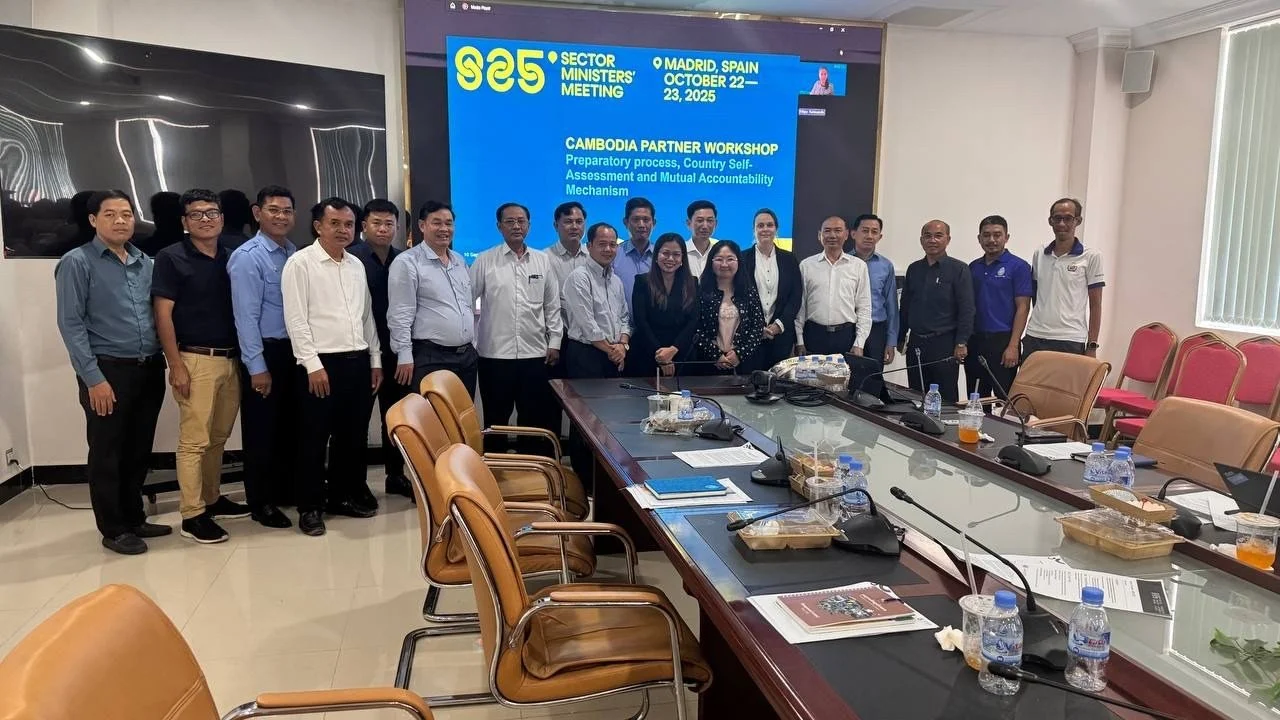
Cambodia Partner Workshop on CSA during the SMM preparatory process.
Several months ago, ministers and partners from around the world gathered for Sanitation and Water for All’s (SWA) Sector Ministers’ Meeting (SMM). This important meeting was built on months of nationally driven, multi-stakeholder reflection and dialogue--anchored in SWA’s commitment to inclusive governance and mutual accountability.
For SWA, the preparatory process is a vital part of every one of its high-level meetings. It is where the partnership’s principles come to life. The preparatory process is government-led and grounded in discussions between as broad a range of actors as possible, working to strengthen the water, sanitation and hygiene sector in their countries. This multi-stakeholder approach has brought sectors together across the world in recent months, to analyse progress, identify challenges and agree on priorities to bring to discussions in Madrid.
With less than five years to achieve the Sustainable Development Goals and growing climate challenges, it’s essential that countries take stock of where their water, sanitation, and hygiene sectors stand. The global context has shifted rapidly: countries face rising debt, shrinking aid, and complex interlinked challenges where water and sanitation must be integrated with climate action, health, and economic development strategies.
With all of these realities, SWA’s ‘Country Self-Assessment’ (CSA) tool has become an increasingly important tool. The CSA has been part of SWA’s partnership toolkit for several years, allowing countries to periodically review sector governance, financing, and institutional performance through a qualitative, participatory process. The CSA brings together government ministries, utilities, regulators, civil society, and development partners to provide a shared narrative and evidence base beyond numbers and averages.
What was new in 2025 was using the CSA systematically as the main preparatory tool for the Sector Ministers’ Meeting. This meant countries arrived in Madrid having recently completed a rigorous, multi-stakeholder review, creating a shared understanding of sector realities and priority challenges to guide ministerial dialogue.
The CSA’s strength lies in its focus on narrative and participation of diverse actors (which SWA partnership calls 'constituencies' like civil society, private sector). Countries use a common framework to assess political will, accountability, financing flows, data systems, and cross-sector integration. The process moves conversations beyond numbers to explore policy dynamics, institutional coordination, and climate risks- all crucial to understand complex sector bottlenecks and opportunities.
To support the 2025 meeting’s theme- “Breaking Silos: Uniting Political Leadership for Water, Sanitation and Climate Action”- the CSA template was updated. It encouraged countries to assess how water, sanitation and hygiene is integrated into climate and development plans, how ministries collaborate, and how sector financing contends with debt and declining aid. This pushed countries to look at water and sanitation through a broader, more interconnected lens.
In the run-up to the Madrid meeting, twenty-two countries submitted comprehensive CSA reports. These reports formed a shared evidence base that elevated the quality and focus of ministerial discussions. Countries like Nepal, Malawi, Indonesia, and Ghana used their CSA findings to identify where they need support- whether tariff reform, stronger regulation, climate-risk planning, or capacity-building. This made the meetings more solution-focused and grounded in national realities.
Even before ministers met, the CSA process helped break down traditional sector silos by bringing together diverse actors to build trust and shared understanding. This multi-stakeholder engagement has proven essential for driving the political leadership and coordinated action needed to accelerate progress toward universal, climate-resilient water and sanitation services.
The SMM culminated in the launch of the High-Level Leaders Compact on Water Security and Resilience (the Madrid Compact)- a political commitment linking water, sanitation, and climate resilience. The CSA process and the Compact together provide a foundation to sustain integrated, multi-sectoral efforts beyond Madrid into COP30 and the 2026 UN Water Conference.
On December 11, SWA is hosting a webinar that takes the work of the Country Self-Assessments and the Sector Ministers' Meeting even further. The discussion will include how to engage governments, development partners, civil society, regulators, utilities, research institutions, and the private sector in translating SMM commitments into concrete, time-bound results at country level and institutional level. It will focus on practical steps, early wins, and mechanisms for alignment—ensuring that the momentum from Madrid leads directly to strengthened policies, budgets, and implementation pathways.
Session 1 Registration (Anglophone Africa and Asia Pacific)
Session 2 Registration (Francophone Africa, Latin America and the Caribbean)
Our work on realizing the human rights to water and sanitation is supported by the European Commission.
